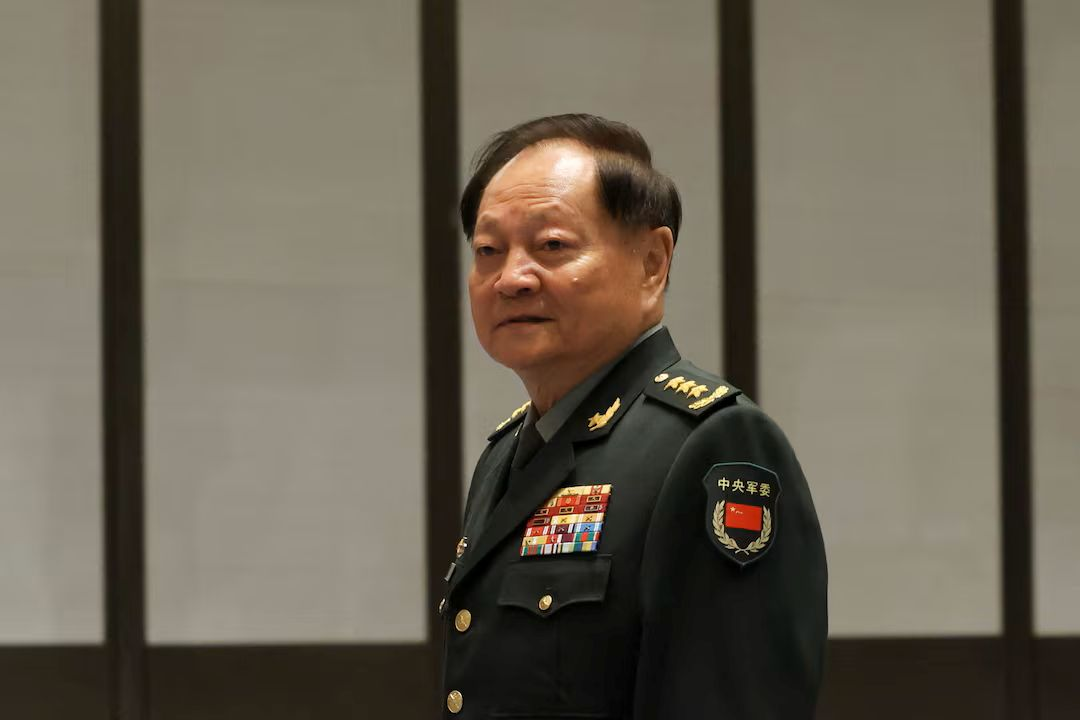
China has removed its highest ranking military officer in a sweeping purge that has unsettled the senior leadership of the People’s Liberation Army and deepened uncertainty about Beijing’s internal power dynamics. The sudden downfall of Gen Zhang Youxia, long regarded as one of the most influential figures in the armed forces, has intensified scrutiny of President Xi Jinping’s grip on the military and raised concerns about command stability at a time of heightened regional tension.
Zhang, 75, served as vice chairman of the Central Military Commission, the Communist Party body that exercises absolute control over the military. His removal, alongside that of Gen Liu Zhenli, leaves the commission with only two remaining members: Xi himself and Gen Zhang Shengmin. Such a pared down leadership structure is unprecedented in modern Chinese politics and has no clear historical parallel since the era of Deng Xiaoping.
The official explanation offered by authorities follows a familiar script. Both generals are under investigation for what the party describes as serious violations of discipline and law, language typically used to signal corruption allegations. State media has framed the action as part of a continuing campaign to enforce strict discipline within the armed forces, emphasizing that rank and seniority do not provide immunity.
Yet the lack of specific charges and the scale of the purge have fueled speculation well beyond corruption. Analysts point to the opaque nature of Chinese politics, where limited information creates fertile ground for rumors ranging from factional infighting to more extreme theories. What is clear, however, is that the removals reinforce Xi’s unchallenged authority. The campaign against senior officers has steadily eliminated figures who once held independent influence, consolidating power at the top.
This concentration of control comes with risks. Zhang Youxia was one of the few remaining senior officers with firsthand combat experience and had longstanding personal ties to Xi, dating back to their fathers’ revolutionary past. His fall sends a stark message through the ranks that loyalty alone offers no protection. That perception may discourage initiative among officers and foster an environment of caution, where decision making becomes increasingly centralized and risk averse.
The disruption also raises questions about the military’s operational effectiveness. The Central Military Commission oversees millions of personnel and directs strategic planning. With much of its senior leadership removed, the PLA faces a potential leadership vacuum that could complicate coordination and long term planning. Some analysts warn that internal turmoil could linger for years as new leaders are elevated under intense political scrutiny.