

A powerful undersea earthquake struck near Russia’s Kamchatka Peninsula early Wednesday, prompting tsunami warnings across the Pacific, including in Japan, the United States, and parts of Russia. The U.S. Geological Survey recorded the magnitude at 8.8, making it one of the strongest seismic events in recent history. The epicenter was located roughly 74 miles southeast of Petropavlovsk-Kamchatsky at a depth of 12.8 miles.
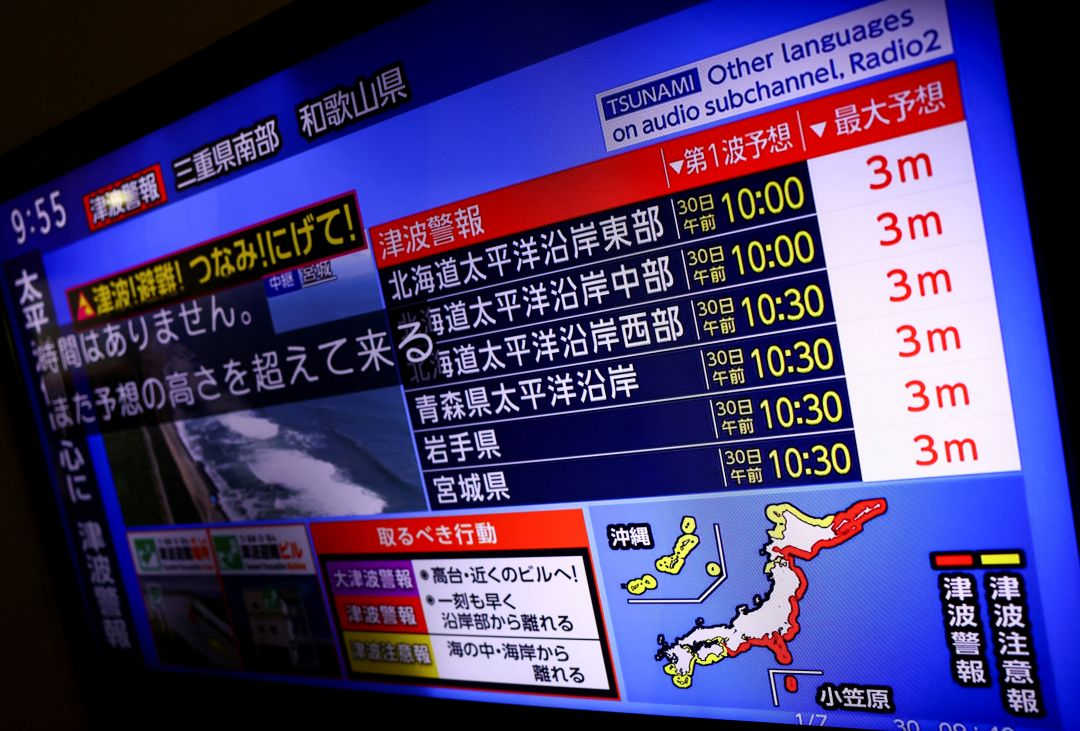
Japan’s Meteorological Agency issued tsunami warnings for much of the country’s eastern coastline, predicting waves up to three meters high. Authorities ordered evacuations in 112 municipalities, affecting nearly two million residents. The tsunami was expected to reach Japan’s coast mid-morning local time, with peak wave activity projected until early afternoon.
In response, Japan’s central government activated an emergency coordination office to oversee evacuation procedures and monitor infrastructure. The Tokyo Electric Power Company confirmed the evacuation of workers from the decommissioned Fukushima Daiichi nuclear facility as a precaution. Travel advisories were issued across multiple prefectures, and rail and ferry services were suspended in affected areas.
In the United States, the National Weather Service issued a tsunami warning for Hawaii and parts of the West Coast, including the coastal areas of California and Alaska’s Samalga Pass. Authorities advised residents in low-lying areas to seek higher ground immediately. The Pacific Tsunami Warning Center projected waves as high as 10 feet in parts of Hawaii.
Hawaii Governor Josh Green signed an emergency proclamation, activating the National Guard and directing state agencies to prepare for coastal flooding. Harbors across the islands were ordered cleared of vessels, and emergency shelters were opened. Officials emphasized that the threat remained fluid and urged the public to follow safety instructions closely.
In California, the Governor’s Office of Emergency Services issued tsunami advisories, although no mandatory evacuations had been ordered as of Wednesday morning. Huntington Beach closed all beaches, piers, and harbors in anticipation of potential surges. Coastal emergency teams remained on standby.
On the Russian side, the Ministry of Emergency Situations reported that tsunami waves had already reached Severo-Kurilsk, flooding parts of the town and a nearby fish processing facility. Local officials confirmed that residents had been moved to higher ground. Structural assessments were underway in Kamchatka, where some buildings sustained damage, including a partial collapse at a school undergoing renovation.
The Pacific Tsunami Warning Center also extended alerts to Ecuador and other coastal areas potentially in the tsunami’s path. As the situation evolves, international agencies are coordinating to monitor aftershocks and assess the potential for further seismic activity.