

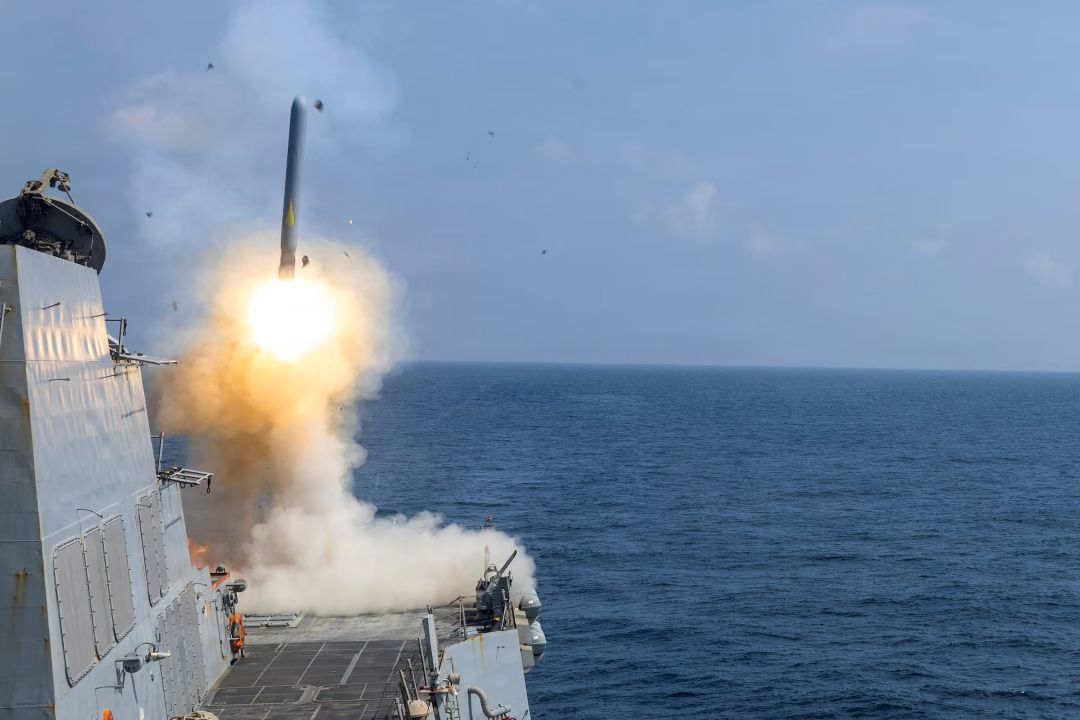
The United States has expended a significant portion of its long range strike arsenal in the ongoing conflict with Iran, firing hundreds of Tomahawk cruise missiles at a pace that far exceeds current production levels, according to defense officials and analysts.
More than 850 Tomahawk missiles have been used in the conflict so far, a figure that sharply outstrips the Pentagon’s typical annual procurement. In most years, the U.S. military acquires fewer than 100 of the missiles, creating a widening gap between usage and replenishment.
The Tomahawk, a precision guided cruise missile launched primarily from Navy ships and submarines, has long been a cornerstone of U.S. military operations. Capable of traveling more than 1,000 miles and striking fortified targets with high accuracy, it is often deployed in the early stages of a conflict to neutralize defenses without risking pilots.
While the Pentagon maintains an estimated stockpile of about 3,100 Tomahawk missiles, the current rate of use has raised concerns about sustainability. Defense experts note that ongoing operations in Iran, along with other global deployments in recent years, have steadily reduced available reserves.
The issue highlights a broader challenge within the U.S. defense industrial base. Production capacity for Tomahawk missiles exists on paper at more than 2,000 units per year, but actual output has remained far lower under peacetime procurement cycles. Analysts say the system is not designed for rapid scaling during high intensity conflicts, limiting the military’s ability to quickly rebuild stockpiles.
Efforts are underway to address the imbalance. Defense contractors, including Raytheon, have entered into agreements with the Pentagon to increase production to as many as 1,000 missiles annually over the coming years. However, these plans are expected to take time to fully implement and are unlikely to provide immediate relief during active operations.
The cost of each missile further complicates the equation. Depending on the variant, a single Tomahawk can cost between $2 million and more than $4 million, making large scale replenishment a significant financial undertaking.
U.S. forces have not relied solely on Tomahawks in the conflict. Lawmakers and defense officials say a range of advanced munitions, including precision strike missiles and air defense interceptors, are being used at a similarly high rate. This broader demand is placing additional strain on supply chains already under pressure from global security commitments.
Pentagon leadership has acknowledged the need to strengthen domestic manufacturing capacity for critical weapons systems. Officials say recent initiatives aim to reduce production delays and expand output across multiple categories of advanced munitions.