

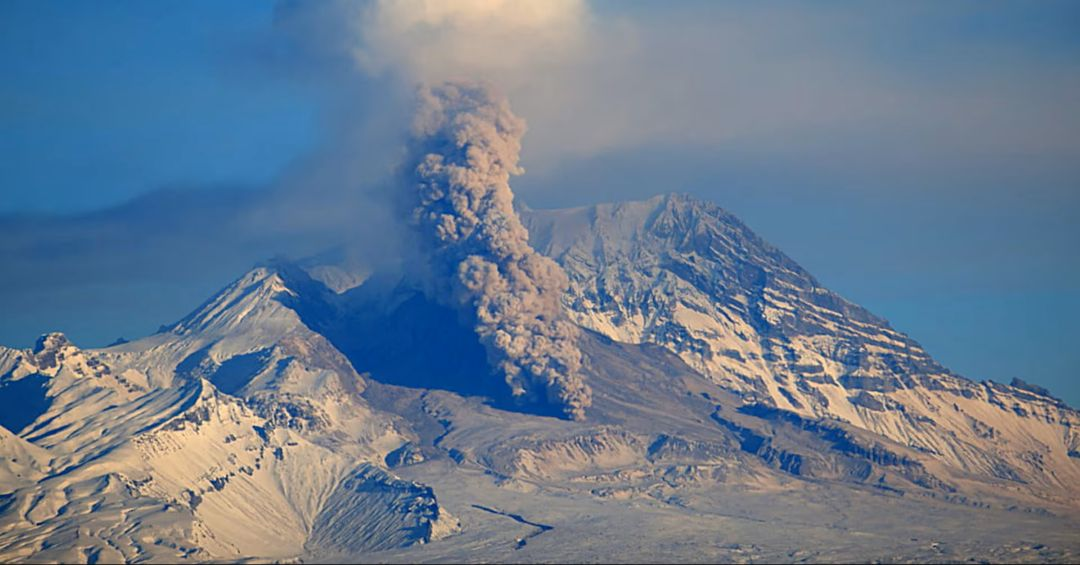
A long-dormant volcano in Russia’s far eastern Kamchatka Peninsula erupted Sunday, just days after a powerful earthquake shook the same region. The Krasheninnikov Volcano, located within the Kronotsky Nature Reserve, released a towering column of ash and gas more than five miles into the atmosphere in what scientists say is its first known eruption in at least 400 years.
The eruption, which began early Sunday morning local time, triggered an aviation red alert due to the height of the ash plume, estimated to have reached approximately 27,000 feet. Authorities later downgraded the warning to orange, indicating ongoing but reduced risk for aircraft flying in the area. According to the Kamchatka Volcanic Eruption Response Team, ash explosions reaching up to 32,800 feet remain possible.
Though visually striking, the eruption has so far posed minimal threat to human life. The surrounding area is sparsely populated, and employees of the nature reserve evacuated the immediate vicinity. Officials emphasized that while this is the first recorded eruption of Krasheninnikov in centuries, such activity is not unusual in the volcanically active Kamchatka region.
The event came just days after a massive 8.8 magnitude earthquake struck off the eastern coast of the peninsula on July 30. The epicenter was located roughly 230 kilometers south of the volcano. The tremor, one of the strongest ever recorded, triggered tsunami warnings across the Pacific, including in Japan, Hawaii, and parts of the United States. Despite its magnitude, the quake caused limited damage, and tsunami waves were smaller than expected.
Seismologists are studying whether the quake and the volcano’s eruption might be connected. While direct causation is unlikely, some researchers believe the seismic activity may have played a role in triggering the event.
Harold Tobin, a geophysics professor at the University of Washington and director of the Pacific Northwest Seismic Network, noted that if the volcano was already in a critical state, the passing seismic waves could have acted as a catalyst. He explained that such waves, though not always powerful at the surface, can alter underground systems, including magma chambers. According to Tobin, even moderate shaking can potentially dislodge materials or shift pressures within a volcano that is close to erupting.
Kamchatka is one of the world’s most active volcanic zones, home to over 300 volcanoes, including around 30 currently classified as active. The region lies along the Pacific Ring of Fire, a seismically volatile belt known for frequent earthquakes and eruptions.